
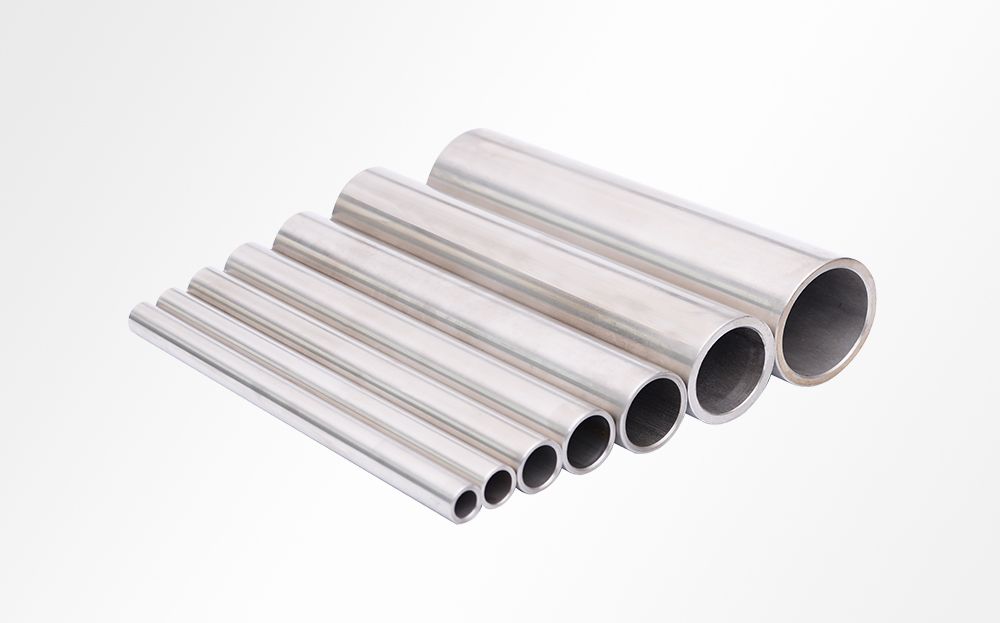
A hollow shaft can reduce mass or provide an internal passage, but it is not a direct replacement for a solid shaft of the same outside diameter. Compare geometry, material condition and end connections before deciding which form belongs on the drawing.
A simple weight comparison
For the same material and length, mass is proportional to cross-sectional area. A solid round shaft has area πD²/4; a hollow round shaft has area π(D² − d²)/4, where D is the outside diameter and d is the inside diameter.
As an illustration, consider a 50 mm outside diameter with a 30 mm bore. The hollow section contains 64% of the cross-sectional area of a solid 50 mm bar, so its ideal uniform-section mass is 36% lower. This calculation excludes end fittings, machining, diameter tolerances and any variation in the bore.
Weight reduction is not an equal-strength claim
For those same ideal circular sections, the bending second moment of area is proportional to D⁴ − d⁴. The hollow example retains 87.04% of the solid section’s value. These ratios describe geometry only. They do not establish allowable load, fatigue life, buckling resistance or the performance of a finished assembly.
Loads, span, supports, material properties, stress concentrations and connection details still require application-specific assessment. An internal bore may also be needed for routing rather than weight reduction. State its function so that unnecessary finishing work is not quoted.
Details that are easy to leave off a hollow-shaft drawing
- Inside diameter and its tolerance over the required length
- Minimum wall or concentricity requirement where relevant to the design
- Whether the bore is a clearance passage, fitted surface or fluid passage
- End threads, shoulders, plugs or connections and their relationship to the bore
- Required deburring, cleaning and protection of the internal passage
- Datum setup for checking outside diameter runout and bore position
Match the catalog to the application
The stainless steel hollow shaft and hollow piston rod are different product enquiries. A shaft used in a machine may require different surfaces and end features from a reciprocating rod working through a seal. Do not assume the same material, coating or inspection requirements apply to both.
Should the inside diameter be finished as accurately as the outside?
Only where the function requires it. A fitted internal surface and a simple routing passage call for different acceptance criteria. Identify the functional surfaces, then specify measurable requirements for each one.
Request a shaft review from Newneng with a drawing showing both diameters, overall length, connection details and intended function. Include load and support information for the responsible designer’s assessment.